Few problems in probability generate as much genuine disbelief as the Monty Hall problem. You're shown three doors: behind one is a car, behind the other two, goats. You pick a door. The host — who knows what's behind every door — opens a different door, always revealing a goat. You're then offered the choice to stick with your original pick or switch to the remaining unopened door. Most people's gut instinct says it doesn't matter, that the odds are now 50/50 between the two remaining doors. That instinct is wrong: switching wins 2/3 of the time, while staying wins only 1/3.
- The full probability-tree breakdown showing exactly why switching wins twice as often
- Why the host's guaranteed, informed action is the key detail intuition misses
- A simulation result confirming the theoretical answer
- Why the problem becomes obvious with 100 doors instead of 3
Setting Up the Problem Precisely
The rules matter enormously here, and stating them precisely is most of the battle: three doors, one car placed uniformly at random. You pick a door, and your choice is also independent of where the car is (you have no information yet). The host, who always knows exactly where the car is, then always opens one of the two remaining doors, and — critically — always reveals a goat, never the car, and never opens your original door. You're then given the choice to switch.
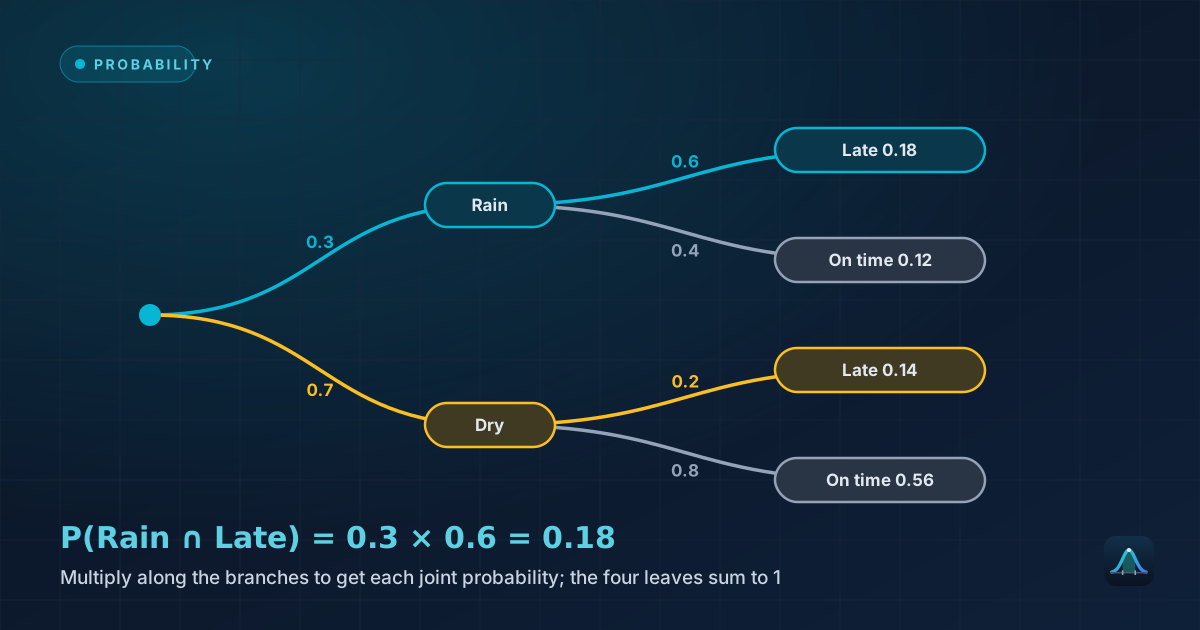
Working Through It With a Probability Tree
Following the same logic as a probability tree: before you pick, the car is equally likely (probability 1/3 each) to be behind Door 1, Door 2, or Door 3. Say you pick Door 1. There are three equally likely scenarios for where the car actually is:
Car behind Door 1 (probability 1/3): your original pick is correct. The host can open either Door 2 or Door 3 (both have goats) — it doesn't matter which. If you switch, you switch away from the car and lose.
Car behind Door 2 (probability 1/3): your original pick is wrong. The host has no choice — Door 3 has a goat and Door 2 has the car, so the host is forced to open Door 3. If you switch, you switch to Door 2 — the car — and win.
Car behind Door 3 (probability 1/3): symmetric to the case above. The host is forced to open Door 2. If you switch, you switch to Door 3 — the car — and win.
Switching wins in exactly 2 of these 3 equally likely scenarios — a 2/3 probability of winning by switching, and therefore exactly 1/3 by staying. This is the entire proof; every detail of the calculation traces back to those three original, equally likely placements of the car.
Confirming It With Simulation
Running 200,000 simulated plays of the game, each following the exact rules above, gives an empirical stay-win rate of 33.3% and an empirical switch-win rate of 66.7% — matching the theoretical 1/3 and 2/3 values essentially exactly, and this kind of large-scale simulation is often what finally convinces skeptics who remain unconvinced by the tree argument alone.
Why Intuition Gets This Wrong
The near-universal instinct is that once one goat door is revealed, the remaining two doors are simply equally likely — a natural but mistaken generalization from situations where information genuinely does arrive at random. The critical detail intuition misses is that the host's reveal is not random: the host is guaranteed to always find and reveal a goat, using guaranteed knowledge of where the car is. This guarantee is what breaks the naive 50/50 instinct — the host's action carries real information (specifically, information correlated with your original 1/3 chance of already being right), and that information doesn't distribute evenly between the two remaining doors once you account for how the host was forced to act in each of the three original scenarios above.
The Trick That Makes It Click: 100 Doors
The classic way to make the result intuitive rather than just mathematically proven is to scale the problem up. Imagine 100 doors, one car, 99 goats. You pick one door — a 1/100 chance of being right. The host then opens 98 of the remaining 99 doors, all revealed goats, leaving your original door and exactly one other door closed. Would you switch? Almost everyone's intuition says yes immediately at this scale: your original pick was overwhelmingly likely to be wrong (99/100), and the host's forced, informed action has concentrated essentially that entire 99/100 probability onto the single remaining unopened door. The 3-door version is exactly the same logic, just with less dramatic numbers — 1/3 against 2/3 doesn't feel as viscerally obvious as 1/100 against 99/100, but the underlying mechanism is identical.
What Would Actually Make It 50/50
It's worth being precise about what would change the answer, since the exact rules matter so much here. If the host opened a door at random (rather than deliberately avoiding the car) and happened to reveal a goat purely by chance, the remaining two doors genuinely would be 50/50 — the host's guaranteed, informed avoidance of the car is specifically what breaks the symmetry in the standard version. This is a genuinely useful test of whether you've understood the mechanism: if you can explain why a random reveal changes the answer to 50/50, you've understood why the informed, guaranteed reveal doesn't. The two versions of the game look identical from the player's point of view in the moment — a goat door has been opened either way — which is exactly why the underlying rule about how the host chose to open it matters so much to the correct answer, even though nothing about what the player directly observes has changed.
Common Mistakes
Treating the host's reveal as new random information about the two remaining doors symmetrically. The reveal is never random — it's a forced, deterministic consequence of where the car actually is, and that forced quality is exactly what the 2/3-vs-1/3 result depends on.
Believing the odds "reset" to 50/50 once a door is eliminated. Your original 1/3 chance of being right doesn't change just because irrelevant information (a goat door you already knew existed somewhere) was revealed — the probability tree above shows precisely why it stays anchored to the original three equally likely placements.
Does it matter which specific door the host opens?
What if the host sometimes doesn't open a door at all?
Is this the same kind of reasoning used in Bayes' theorem?
Has this actually been tested with real people, not just mathematically?
Share this article
Written by
Statistics Fundamentals Editorial Team
Written and reviewed by our team of statistics educators. Content is aligned with GCSE, A-Level, AP Statistics, and undergraduate curricula.
About Statistics Fundamentals →