Probability is the mathematics of uncertainty — a way of putting precise numbers on how likely something is to happen, ranging from 0 (impossible) to 1 (certain). It's the foundation everything else in statistics is built on: without a rigorous notion of probability, p-values, confidence intervals, and hypothesis tests would have nothing to stand on. This guide covers the core rules that every other probability calculation, however complex, ultimately reduces to.
- How probability is formally defined, and the three basic properties every probability must satisfy
- The addition rule and multiplication rule, with worked examples
- The difference between independent and mutually exclusive events — a genuinely common point of confusion
- Conditional probability, and how it changes what you know
The Basic Definition
Every probability calculation starts from a clearly defined sample space — the complete set of all possible outcomes. Get the sample space wrong (miss an outcome, double-count one, or misjudge whether outcomes are truly equally likely) and every probability calculated from it will be wrong too, however carefully the arithmetic that follows is done. Writing out the sample space explicitly, even for a seemingly obvious case like a coin flip or die roll, is a habit worth keeping for more complex problems where it's genuinely easy to miss a case.
For an event A with equally likely outcomes, classical probability is defined as:
Rolling a fair six-sided die and asking for the probability of rolling a 4: there's 1 favorable outcome out of 6 equally likely ones, so P(4) = 1/6. Every valid probability must satisfy two basic properties: it must lie between 0 and 1 inclusive, and the probabilities of all possible outcomes in a sample space must sum to exactly 1.
The Addition Rule
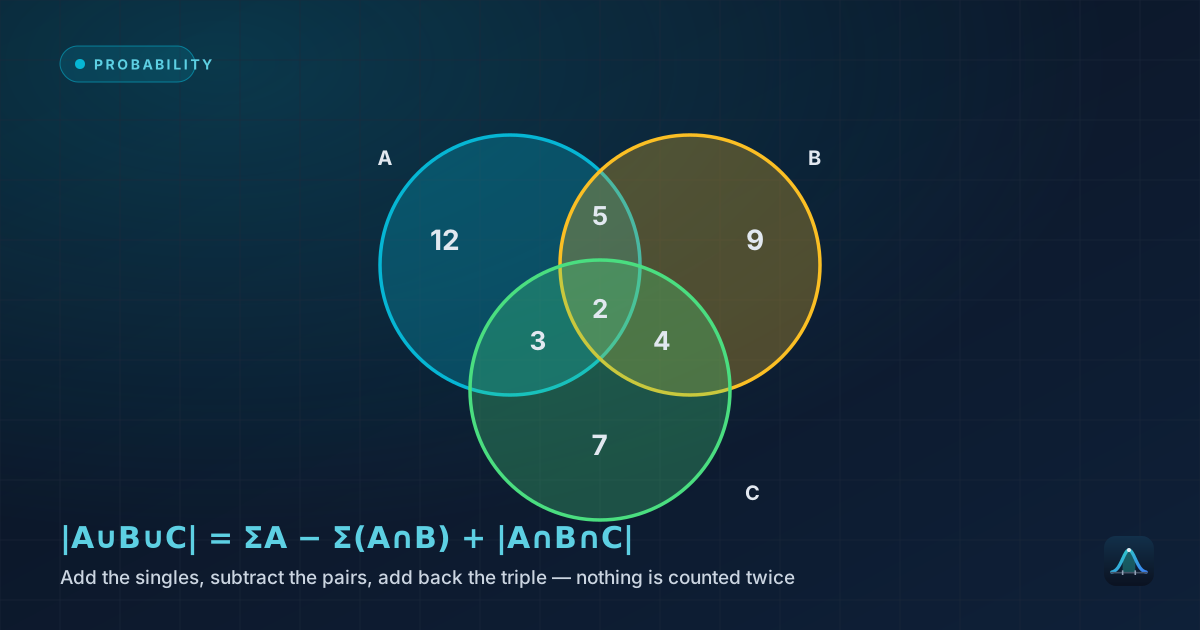
The addition rule finds the probability that at least one of two events occurs:
The subtraction at the end matters — without it, outcomes belonging to both A and B would be counted twice. If A and B are mutually exclusive (they can never both happen — like rolling a 2 and rolling a 5 on the same single roll), P(A∩B) = 0, and the formula simplifies to just P(A) + P(B).
Example: drawing a single card from a standard deck, what's the probability of drawing a King or a Heart? P(King) = 4/52. P(Heart) = 13/52. P(King and Heart) = 1/52 (the King of Hearts specifically). P(King or Heart) = 4/52 + 13/52 − 1/52 = 16/52 = 4/13.
The Multiplication Rule
The multiplication rule finds the probability that both of two events occur:
P(B|A) reads "the probability of B, given that A has already happened" — this is conditional probability, covered fully below. When A and B are independent (knowing A happened tells you nothing about whether B happens), P(B|A) simplifies to just P(B), giving the simpler independent-events version: P(A∩B) = P(A) × P(B).
Example: flipping a fair coin twice, what's the probability of getting heads both times? The two flips are independent — the first flip has no influence on the second. P(HH) = P(H) × P(H) = 0.5 × 0.5 = 0.25.
These sound similar but describe opposite relationships. Mutually exclusive events cannot both happen (P(A∩B) = 0) — knowing A happened tells you B definitely did NOT happen, which is a strong dependency, not independence. Independent events genuinely have no relationship — knowing A happened tells you nothing about B. In fact, two events with nonzero probability can never be both mutually exclusive and independent at the same time; if you think you have both, one of your definitions is wrong.
Conditional Probability
Conditional probability asks: given that we already know something happened, how does that change the probability of something else?
Example: in a class of 30 students, 18 study French, 12 study Spanish, and 6 study both. If a student studies French, what's the probability they also study Spanish? P(Spanish|French) = P(both)/P(French) = (6/30)/(18/30) = 6/18 = 1/3. Notice this is different from the unconditional P(Spanish) = 12/30 = 2/5 — knowing a student studies French genuinely changes the probability estimate for Spanish, because the two subjects aren't independent in this class.
Complementary Events
The complement of event A (written A') is "A does not happen." Since the probabilities of all possible outcomes must sum to 1:
This is often the fastest route to a calculation that looks complicated stated directly. "What's the probability of at least one 6 in four rolls of a die?" is much easier to solve as 1 − P(no 6 in four rolls) than by directly adding up the probabilities of exactly one 6, exactly two 6s, and so on.
Worked example: P(no 6 on one roll) = 5/6. P(no 6 in four independent rolls) = (5/6)⁴ ≈ 0.482. P(at least one 6) = 1 − 0.482 = 0.518, just over half.
Tree Diagrams: Visualizing Sequential Probability
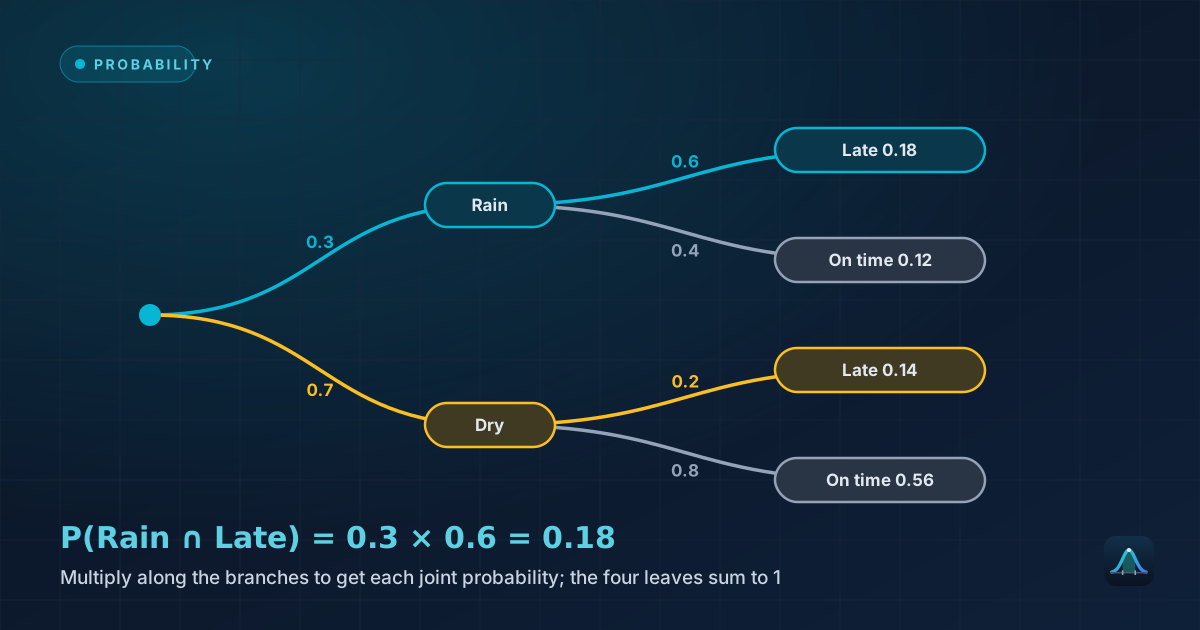
For problems involving a sequence of events, a probability tree diagram makes the multiplication rule visual and much harder to get wrong: each branch represents an outcome, labelled with its probability, and multiplying along a path gives the probability of that specific sequence. Summing the probabilities of every path that satisfies your event of interest gives the final answer. This is especially valuable for problems involving sampling without replacement, where probabilities genuinely change at each step.
A Trickier Worked Example: Sampling Without Replacement
Problem: A bag contains 5 red and 3 blue marbles. Two marbles are drawn without replacement. What's the probability both are red?
First draw: P(red) = 5/8
Second draw (given first was red): now 4 red and 3 blue remain out of 7 total → P(red|first red) = 4/7
Both red: P(RR) = (5/8) × (4/7) = 20/56 = 5/14
The key detail: because the marbles aren't replaced, the second draw's probability genuinely depends on the outcome of the first — these events are not independent, and using P(red) = 5/8 for both draws (as you would with replacement) would give a wrong answer.
Real-World Uses
Insurance and actuarial science: insurers price policies by calculating the probability of claims (death, accident, illness) across large pools of policyholders, using historical data as the empirical basis for what would otherwise be theoretical probability calculations — the entire industry is applied probability at scale.
Medical testing: conditional probability is central to interpreting diagnostic test results correctly — the probability a test is positive given you have a disease is very different from the probability you have the disease given a positive test, and confusing the two (a version of the "prosecutor's fallacy") has led to real, serious misdiagnoses. This exact distinction is what Bayes' theorem is built to handle correctly.
Genetics: the probability that a child inherits a particular genetic trait follows directly from the multiplication and addition rules applied to each parent's possible allele combinations — this is exactly why basic probability is taught alongside Mendelian genetics in many biology curricula.
Quality control: manufacturers use probability to estimate the likelihood of defective batches given a known defect rate, directly informing sampling plans and acceptance criteria for incoming shipments.
Common Mistakes
The gambler's fallacy. Believing that past independent outcomes influence future ones — "the coin has landed heads five times in a row, so tails is due" — is a genuine, well-documented cognitive bias. For truly independent events like fair coin flips, each flip has exactly the same probability regardless of history; the coin has no memory.
Confusing P(A|B) with P(B|A). These are generally different quantities, and swapping them is one of the most consequential errors in applied probability — it's the exact mistake behind many misinterpreted medical test results and, famously, several wrongful court convictions built on misstated forensic probabilities.
Forgetting to check independence before multiplying. The simple multiplication rule P(A)×P(B) only applies when A and B are genuinely independent. Applying it to dependent events — like drawing cards without replacement — silently produces a wrong answer that looks plausible.
Can a probability be negative or greater than 1?
What's the difference between theoretical and empirical probability?
How is probability different from odds?
Why does sampling without replacement change the probability calculation?
Share this article
Written by
Statistics Fundamentals Editorial Team
Written and reviewed by our team of statistics educators. Content is aligned with GCSE, A-Level, AP Statistics, and undergraduate curricula.
About Statistics Fundamentals →